Workers Compensation Lawyer Liverpool

Accredited Specialists in Personal Injury
Your Trusted Legal Partners
On Your Side
State Law Group

If you've been injured in at work, you may be entitled to compensation. With a dedicated team of Accredited Specialists in Personal Injury Law, our compensation lawyers have helped hundreds of injured clients across Western Sydney recover the compensation they deserve.

Google Badge
Google Review Star RatingGoogle Review Star RatingGoogle Review Star RatingGoogle Review Star RatingGoogle Review Star Rating
Rated 5.0 out of 5
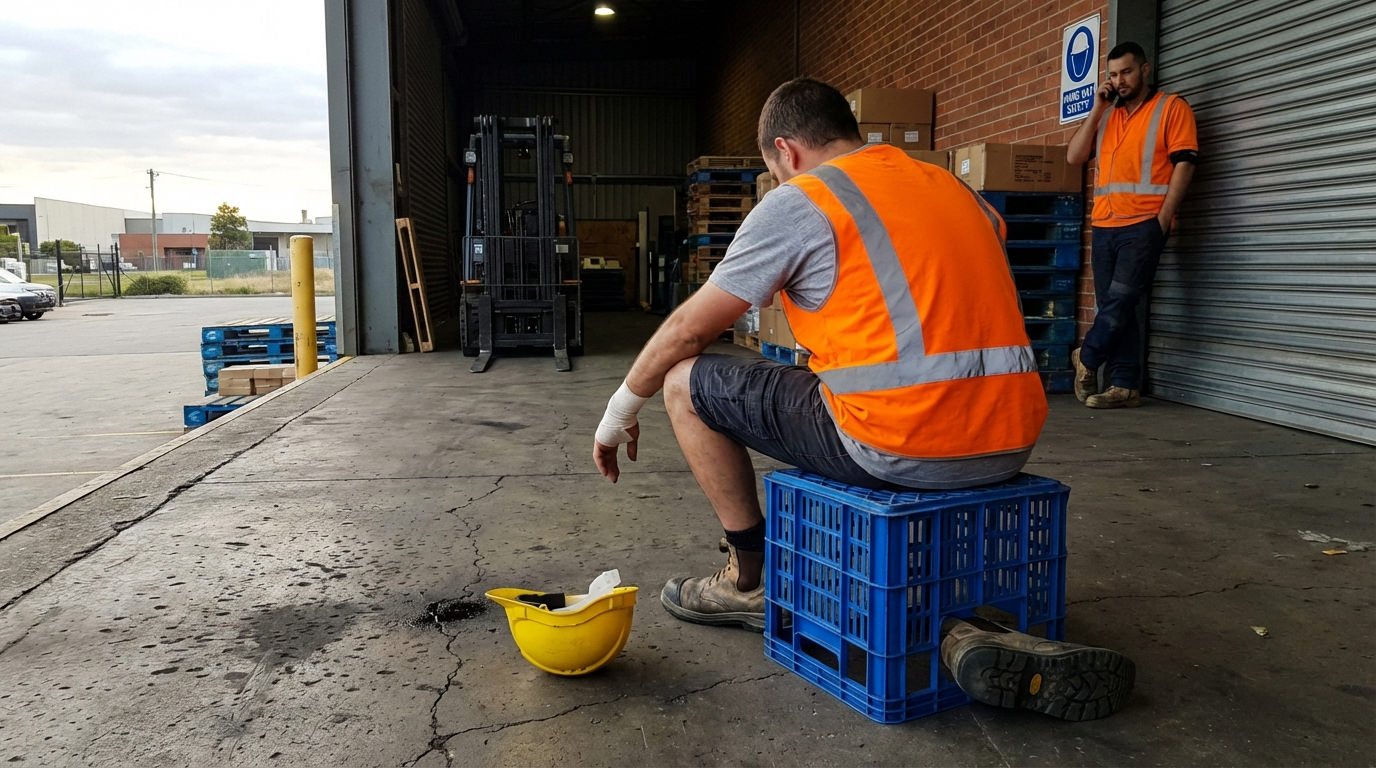
A worker with a bandaged wrist sitting on a crate outside a Western Sydney warehouse loading dock, hard hat on the ground beside them, while a coworker makes a phone call nearby
Gold medal with a trophy in the center and a blue ribbon below reading 'AWARD-WINNING'.

Liverpool's Award-Winning Law Firm

Recognised as 2025 Liverpool Business of the Year and Australian Small Business Champion. Excellence you can trust.
Gold medal with stacked coins and a dollar symbol in the center, overlaid with a blue ribbon reading '$350 MILLION WON'.

Proven Track Record

We've secured over $350 million for injured clients with a 99% success rate. Our results speak louder than promises.
Gold seal with handshake graphic and a blue ribbon reading 'NO WIN, NO FEE*'.

No Win, No Fee Guarantee*

You won't pay us unless we win your personal injury compensation claim. Accessible legal help, without the upfront cost.
Our lawyers have featured in

Workplace Injuries in Liverpool

Liverpool's warehouses, construction sites, factories, and logistics hubs generate thousands of workplace injuries every year. The Moorebank Intermodal Terminal, Prestons industrial estate, and Warwick Farm distribution centres employ thousands of workers in physically demanding roles. When something goes wrong, the consequences are serious.

  • Forklift collisions and falling stock injuries in Moorebank warehouses.
  • Falls from height and struck-by incidents on Liverpool CBD construction sites.
  • Repetitive strain injuries in Prestons manufacturing plants.
  • Back injuries from manual handling in Warwick Farm distribution centres.
  • Chemical exposure and respiratory conditions in industrial processing facilities.

Every one of these injuries triggers a workers compensation claim. But filing the claim is just the first step. What happens next determines whether you receive the support you're entitled to or get pushed back to work before you've recovered.

How the System Works Against Injured Workers

After a Liverpool workplace injury, the insurer controls your claim. They choose the independent medical examiner who assesses your injuries. They decide when to dispute your capacity for work. They schedule you for reviews designed to reduce your weekly payments. The system creates pressure to settle early or return to work before you're ready.

Injured workers who don't understand how these decisions compound often accept outcomes far below what they're entitled to. An unfavourable IME report becomes the basis for reducing weekly payments. Reduced payments create financial pressure. Financial pressure leads to accepting a lump sum settlement that doesn't reflect the true long-term cost of the injury.

How We Protect Liverpool Workers' Claims

We intervene at the points where insurers gain advantage. When the insurer schedules an IME, we ensure you understand what's being assessed and why. When they dispute your capacity, we obtain treating specialist evidence that directly addresses their argument. When they pressure an early settlement, we calculate the full long-term value so you know what you're giving up. Every decision in a workers compensation claim builds on the last. Getting each one right changes the final outcome.

Liverpool Workers We've Helped

Our workers compensation clients include warehouse workers, construction labourers, factory operators, truck drivers, and office workers from across Liverpool's employment centres. We act for injured workers from Liverpool, Moorebank, Prestons, Casula, Warwick Farm, Ingleburn, Glenfield, Chipping Norton, Green Valley, Hinchinbrook, Middleton Grange, and across South West Sydney.

Frequently Asked Questions

What types of workplace injuries can I claim for?

Workers compensation covers a wide range of physical and mental injuries that happen because of your job. The only test is whether the injury "arose out of or in the course of employment." If it did, you can claim.

Physical injuries include:

  • Falls, slips, and trips at work.
  • Crush injuries from machinery or heavy objects.
  • Burns, cuts, and electrocution.
  • Back injuries from lifting, bending, or carrying.
  • Vehicle accidents while driving for work.
  • Repetitive strain injuries (RSI) from doing the same task over and over.

Psychological injuries are also covered:

  • PTSD from a traumatic event at work (like an armed robbery or serious accident).
  • Depression or anxiety caused by bullying, harassment, or discrimination.
  • Stress-related conditions from unsafe workloads or poor management.

Occupational diseases develop slowly from workplace exposure:

  • Noise-induced hearing loss from loud machinery.
  • Silicosis or asbestos-related diseases from dust exposure.
  • Skin conditions from chemical contact.

You can also claim if your job made a pre-existing condition worse. For example, if you already had mild knee arthritis but warehouse work turned it into something that needs surgery, the worsening is a valid claim.

Workers comp is a no-fault system. You don't need to prove your employer did anything wrong. You just need to show the injury came from work.

How much compensation can I get for a workplace injury?

There's no single payout figure for a workplace injury. Your compensation is made up of several parts, and the total depends on the type of injury, how serious it is, and how it affects your ability to work.

Weekly payments replace your lost income while you recover. You get 95% of your pre-injury average weekly earnings for the first 13 weeks, then 80% after that. Payments are capped at the indexed maximum weekly rate set by SIRA (adjusted each financial year). These payments keep going while you're unable to work.

Medical expenses are covered with no dollar limit. Your employer's insurer pays for surgery, hospital stays, physio, psychology, medication, scans, and rehab under Section 60 of the Workers Compensation Act 1987.

Permanent impairment lump sum is paid once your condition stabilises. A doctor assesses your permanent functional loss as a percentage using the AMA Guides. Lump sums range from about $1,700 (for 1% impairment) to over $540,000 (for the most severe injuries). A 20% impairment might get around $52,000. These figures are updated each year.

Pain and suffering is a separate lump sum under Section 67, paid on top of the impairment amount.

Work injury damages are common law damages you can claim if your employer was at fault and your impairment is above 15%. These can be worth $100,000 to $500,000 or more depending on your age, earnings, and injury.

We calculate all of these for your specific situation during a free consultation.

How does No Win No Fee work for workers compensation?

No Win No Fee means you pay zero legal fees unless we get a result for you. It's that simple. If we don't recover compensation, you owe us nothing.

Here's how the process works:

  1. We assess your claim in a free consultation.
  2. If we take your case, we handle everything: lodging the claim, dealing with the insurer, getting medical reports, and running any disputes.
  3. You pay nothing while the claim is in progress.
  4. If we recover compensation, our legal fees come out of your payout.
  5. If we don't recover anything, you don't pay.

Our fees follow the rules set by the Law Society of NSW. We explain all costs before you sign anything, so there are no surprises.

What about other costs? Most expenses like medical reports, expert assessments, and filing fees are covered or kept small. We sort out who pays what upfront.

ILARS funding is another option. The Independent Legal Assistance and Review Service (run by WIRO) funds legal help for injured workers in disputed claims. ILARS covers approved legal costs for cases that pass a merit review. Many workers get legal help at no personal cost through this scheme, even separate from No Win No Fee.

The bottom line: money should never stop you from getting legal help after a workplace injury. Between No Win No Fee and ILARS, there's a path for every injured worker.

How long do I have to make a workers compensation claim?

You have 6 months from the date of your workplace injury to lodge a claim. This deadline is strict. Missing it can block you from getting statutory benefits like weekly payments, medical expenses, and lump sums.

Our strong advice: don't wait. Lodge your claim as soon as possible after the injury. Contact your employer's workers compensation coordinator, get a claim form, and submit it within days. The sooner you lodge, the sooner your benefits start.

Psychological injuries follow the same 6-month rule, but the start date can be different. For a single traumatic event (like an assault), the clock starts on the day it happened. For ongoing issues like bullying or harassment, the 6 months runs from when your condition first showed up or when you should have realised it was work-related.

What if you're late? If you miss the 6-month deadline, you may still have options in special cases, but your claim becomes much harder. Courts have some flexibility on late notification, but you'll need a good reason for the delay.

Work injury damages (common law claims against your employer for negligence) have a separate 3-year deadline from the injury date. These claims are different from standard workers comp and need specific legal advice.

Practical tip: tell your employer about the injury straight away, even if you're not sure how bad it is. If you wait and symptoms get worse, the insurer may question why you didn't report it sooner.

Can I claim workers comp if the accident was partly my fault?

Yes. Workers compensation is a no-fault system. It doesn't matter who caused the accident. If you got hurt doing your job, you're covered.

This is one of the biggest differences between workers comp and other injury claims. In a car accident or public liability case, your payout can be reduced if you were partly to blame. Workers comp doesn't work that way. Your weekly payments, medical expenses, and lump sums are the same whether the accident was 100% your employer's fault, 100% your fault, or somewhere in between.

Example: You're carrying boxes up stairs in a warehouse and fall because you weren't paying full attention. Your foot slipped and you hurt your back. Even though your own distraction played a part, you're fully entitled to workers comp. Weekly payments, medical treatment, and a lump sum if there's permanent damage.

The only exception is serious and willful misconduct. This means things like deliberately ignoring safety rules after being warned, or being severely intoxicated at work. Even then, courts read this defence very narrowly. It only covers extreme behaviour. Normal human mistakes, carelessness, or poor judgement don't count as misconduct.

One thing to note: if you're also pursuing work injury damages (a common law negligence claim on top of workers comp), your own fault can reduce that payout. But your standard workers comp benefits stay the same no matter what.

What evidence do I need for a workers compensation claim?

Good evidence makes the difference between a smooth claim and a disputed one. Here's what you should gather as soon as possible after a workplace injury.

Medical Certificate of Capacity is the first thing you need. Your treating doctor fills this out. It documents your injury, how it happened, what work you can and can't do, and what treatment you need. This certificate starts the claims process and triggers provisional liability payments (which your employer's insurer must start within 7 days).

Incident report should be filed with your employer on the day of the injury or as soon as possible. Most workplaces have a standard form. Write down exactly what happened, where, and when. Keep a copy for yourself.

Medical records and scans build the picture over time. Keep copies of GP notes, specialist reports, X-rays, MRIs, physio records, and psychology notes. These show the injury timeline and how it affects your daily life and work.

Witness statements from coworkers who saw the accident or know about the conditions that caused it. Written statements with names, dates, and contact details carry real weight.

Photos and videos of the accident scene, any hazards, faulty equipment, or your injuries. Take these on the day if you can.

Pay records prove your pre-injury earnings for weekly payment calculations. Gather recent payslips (at least 26 weeks' worth), your employment contract, and any records of overtime or allowances.

Workplace documents like safety reports, training records, maintenance logs, and any complaints you made about unsafe conditions. These matter if the insurer disputes your claim or if you pursue work injury damages.

What if my employer disputes my workers compensation claim?

Disputes are common in workers comp. Your employer's insurer (usually icare) might argue that your injury didn't come from work or that you don't need the treatment you're getting. They may also claim you're able to return to work sooner than your doctor says.

What happens first: the insurer sends you written reasons for the dispute. You then have the right to respond with more evidence, like medical reports, witness statements, or workplace records. The insurer must reconsider after seeing your response.

If they don't back down, you can take the dispute to the Personal Injury Commission (PIC). The PIC replaced the old Workers Compensation Commission on 1 March 2021. It's an independent tribunal that decides workers comp disputes.

At a PIC hearing, both sides present evidence. You attend with your lawyer, put forward medical reports and witness statements, and challenge the insurer's arguments. The PIC then makes a binding decision on your entitlements.

Common things insurers dispute:

  • Whether the injury is work-related (they may blame a pre-existing condition).
  • How long you're unable to work (they may push for an early return).
  • Whether treatment is reasonable (they may refuse to pay for surgery or therapy).
  • Your permanent impairment percentage (they may hire their own doctor to argue a lower figure).
  • Weekly payment amounts (they may dispute your earnings calculations).

WIRO (WorkCover Independent Review Office) also helps injured workers. They review insurer conduct, handle complaints, and fund legal help through ILARS.

Having a workers comp lawyer makes a real difference in disputes. We prepare the evidence, write the submissions, and argue your case at PIC. Most disputes settle in the worker's favour with proper legal backing.

What weekly payments can I receive while off work?

Weekly payments replace your lost income while you recover from a workplace injury. The amount depends on what you earned before the injury.

First 13 weeks: you get 95% of your pre-injury average weekly earnings, up to the maximum weekly rate set by SIRA (adjusted each year).

After 13 weeks: the rate drops to 80% of your pre-injury earnings, still capped at the same maximum.

Example: if you earned $1,000 a week before your injury, you'd get $950 a week for the first 13 weeks, then $800 a week after that.

How long do payments last? They continue while you remain unable to work. The insurer reviews your capacity from time to time and may ask for updated medical certificates. Once you reach "maximum medical improvement" (your condition has stabilised and further treatment won't make a big difference), weekly payments usually stop. At that point, you're assessed for a permanent impairment lump sum.

Maximum medical improvement doesn't mean you're fully healed. It means your condition is as good as it's going to get with treatment. You might still have pain, limits on what you can do, or reduced work capacity.

Watch out for early return-to-work pressure. Insurers sometimes argue you can do "light duties" before you're ready. If your doctor says you're not fit, your doctor's opinion carries weight. We challenge any attempts to cut your payments early.

Casual workers have their earnings averaged over the 26 weeks before the injury, which can mean lower weekly amounts but the same entitlements.

Can I claim for psychological injuries at work?

Yes. Workers compensation fully covers psychological injuries caused by your job. This includes PTSD, depression, anxiety, adjustment disorders, and conditions caused by bullying, harassment, assault, or excessive workplace stress.

To have a valid claim, you need three things:

A diagnosed condition. A doctor, psychiatrist, or psychologist must give you a formal diagnosis. Feeling stressed at work isn't enough on its own. You need a recognised mental health condition like major depression, anxiety disorder, or PTSD.

A link to your job. The injury must have come from your work. Work doesn't need to be the only cause, but it must be a major factor. Common examples include:

  • Witnessing a serious accident or death at work.
  • Being assaulted or threatened on the job.
  • Sustained bullying or harassment from a manager or coworker.
  • Discrimination based on race, gender, or disability.
  • Unsafe workloads that your employer refused to address.

Foreseeability. A fair employer would have seen that their conduct or the work conditions could cause mental harm.

Who makes these claims? Healthcare workers dealing with patient violence. Retail staff hit by armed robberies. Office workers worn down by ongoing bullying. Construction workers shaken by serious site accidents. Warehouse staff ground down by bad management.

These claims can be harder to prove than physical injuries because the damage isn't visible. Medical evidence from a psychiatrist or psychologist is critical. We help you build the strongest possible case.

Can I claim workers comp if I'm a casual or contractor?

Casual workers: yes, 100%. Being casual doesn't change your workers compensation rights. Casual employees get the same entitlements as permanent staff: weekly payments, medical expenses, and lump sums.

The only difference is how weekly payments are calculated. Because casual income varies, the insurer works out your average weekly earnings over the 26 weeks before the injury. If you worked irregular hours, the average might be lower than a full-time worker's, but you're still fully covered.

Independent contractors: this is trickier. Contractors are generally not covered because they're not classed as employees. But the label on your contract doesn't always match reality.

Some workers called "contractors" are really employees in the eyes of the law. Courts look at the real working setup, not just the paperwork. They ask:

  • Who controls when, where, and how you work.
  • Who provides the tools and gear.
  • Can you hire someone else to do the work.
  • Do you work for one business or have several clients.
  • How built-in you are to the day-to-day business.

Example: a delivery driver labelled as a "contractor" but using the company van, following company routes, wearing a company uniform, and reporting to a boss is probably an employee with full workers comp rights.

Deemed workers: some types of contractors are covered no matter what. Labour hire workers, some delivery drivers, and certain subcontractors in specific industries are "deemed workers" under the Workers Compensation Act 1987.

If you've been told you're a contractor and can't claim, get legal advice before you accept that. We look at your real working setup and advise if you're covered.

What is a whole person impairment assessment?

A whole person impairment (WPI) assessment is the medical exam that determines how much permanent damage your workplace injury has caused. It's one of the most important steps in your claim because it directly sets the size of your lump sum payout.

How it works: once your condition has stabilised (meaning further treatment won't make a big improvement), a specialist doctor examines you. They measure things like range of motion, strength, sensation, and function. They compare your current state against what's normal, using standardised tables from the AMA Guides to the Evaluation of Permanent Impairment (6th edition).

The doctor gives your impairment as a percentage. Higher percentages mean larger lump sums.

What the numbers look like:

  • A knee injury with 30 degrees less movement might be rated at 15% WPI, worth roughly $26,000.
  • A back injury with nerve damage and loss of function might be rated at 20% WPI, worth roughly $52,000.
  • The most severe injuries (catastrophic brain damage, paraplegia) can reach $540,000 or more.

All these figures are set by legislation and updated each year.

Why WPI matters beyond the lump sum: if your WPI is above 15%, you can also pursue work injury damages (a common law claim against your employer for negligence). This opens up a separate, often much larger, payout for lost earning capacity and pain and suffering.

Disputes are common. The insurer will often send you to their own doctor, who may rate your impairment lower than your treating specialist. We get independent medical assessments to challenge low ratings and push for a fair result at the Personal Injury Commission.

Can I be sacked while on workers compensation?

No. Your employer cannot fire you because you claimed workers comp or because you're off work with a workplace injury. That's against the law.

The Workplace Injury Management and Workers Compensation Act 1998 makes it illegal to sack someone for:

  • Notifying their employer of a workplace injury.
  • Lodging a workers compensation claim.
  • Being unable to work because of a workplace injury.

What if they dress it up as something else? Some employers try to get around this by calling it a "restructure" or "redundancy." If your position is made redundant while you're on workers comp but similar roles survive, that looks like a sham redundancy. Courts see through this.

Example: you're on workers comp after a back injury. Your employer says your position no longer exists due to a restructure. But two coworkers doing the same job keep theirs. That's likely an unlawful dismissal connected to your injury.

What can you do if you're sacked? You have several options:

  • Unfair dismissal claim through the Fair Work Commission.
  • Reinstatement order to get your job back.
  • Compensation for lost wages covering the period you were out of work because of the sacking.
  • General protections claim if the dismissal was connected to exercising your workplace right to claim compensation.

Your employer CAN dismiss you for genuine reasons unrelated to your injury. But even then, they must follow proper process: written notice, a chance for you to respond, and clear reasons. Rushing to sack an injured worker is risky for employers and easy for lawyers to challenge.

If you've been let go while on workers comp, get legal advice straight away.

Liverpool office

WHY CHOOSE US

The Right Lawyers Make All the Difference

When your compensation claim matters, you need more than just a lawyer. You need proven specialists who deliver results.

Google Badge
Google Review Star RatingGoogle Review Star RatingGoogle Review Star RatingGoogle Review Star RatingGoogle Review Star Rating
Rated 5.0 out of 5
Gold seal with text 'Personal Injury Law Accredited Specialist' surrounding a stylized black and blue emblem in the center.
Medical Scans Compensation Claim

Accredited Specialists in Personal Injury Law

Our lawyers hold the highest qualification in NSW personal injury law. Only 5% of lawyers achieve this elite accreditation status.

Gold badge featuring a map with a location pin and a blue ribbon labeled Western Sydney.
Multilingual Clients

10 Years Serving Western Sydney

Based in Liverpool since 2015, we've helped thousands of local families secure fair compensation. Your trusted community advocates.

Gold medal with a globe in the center surrounded by speech bubbles and a blue ribbon reading 'MULTILINGUAL'.
Full Service Legal Support

We Speak Your Language

Get help comfortably in English, Assyrian, Arabic, Chaldean, Vietnamese, Filipino, Mandarin, and Cantonese.

Gold seal badge with scales of justice symbol and blue ribbon reading 'FREE CLAIM CHECK'.
Full Service Legal Support

Free Initial Consultation

Understand your rights and entitlements with no obligation. Book your free consultation with our Liverpool team today.

Gold seal with a checklist icon and a blue ribbon reading 'STRESS FREE'.
Full Service Legal Support

We Handle Everything

We do the heavy lifting handling paperwork, insurers, medical reports, forms, and deadlines so you can focus on treatment and recovery.

Gold embossed badge with dollar sign, money symbols, and a blue ribbon reading 'Maximum Compensation'.
Full Service Legal Support

We Fight For Maximum Compensation

If insurers won't offer fair compensation, we're ready to litigate. Our trial-tested lawyers fight for your rights in Local and District Courts.

HOW IT WORKS

We make the legal process simple, clear, and stress-free so you can focus on recovery while we focus on results.
Consult Icon
1

Schedule Your consultation

Simply fill in the contact form and our team will reach out to you in the next few days to. Your initial consultation is free, and your information will be kept confidential.
Law Icon
2

Case assessment, COsts & Budgeting

At your consultation we will analyse your case and collect information so that we can provide tailored legal advice to meet your needs.
Negotiate Icon
3

We Handle the Hard Stuff for you

From medical reports to insurer negotiations, we take care of the paperwork, deadlines, and legal strategy so you don’t have to.
Support Icon
4

You Get Paid, We Stay By Your Side

We work hard to secure your maximum payout. Even after settlement, we support you with next steps, final paperwork, and peace of mind.

Talk to a lawyer about your case

Book a consultation with us today to learn about the options you have to protect your best interests.

  • Award-winning Australian law firm
  • Over $350 million won in compensation
  • 99% win rate in personal injury claims
  • No win, no fee claim guarantee
  • Google Badge
State *
Area of law *
First name *
Last name *
Phone number *
Email address *
Situation *
Thank you! Your submission has been received and we will endeavour to respond in the next 24 hours.
Oops! Something went wrong while submitting the form. Try emailing us directly instead at admin@statelawgroup.com.au